

Calgary Stampede Crowd Surge: What Alberta Security Guards Must Learn About Event Safety
Last Updated on March 26, 2026
Introduction
The Calgary Stampede is one of Alberta’s largest and most iconic events, drawing over a million visitors every year. But during a recent free concert featuring Don Toliver, what should have been a highlight quickly turned into a dangerous crowd surge situation.
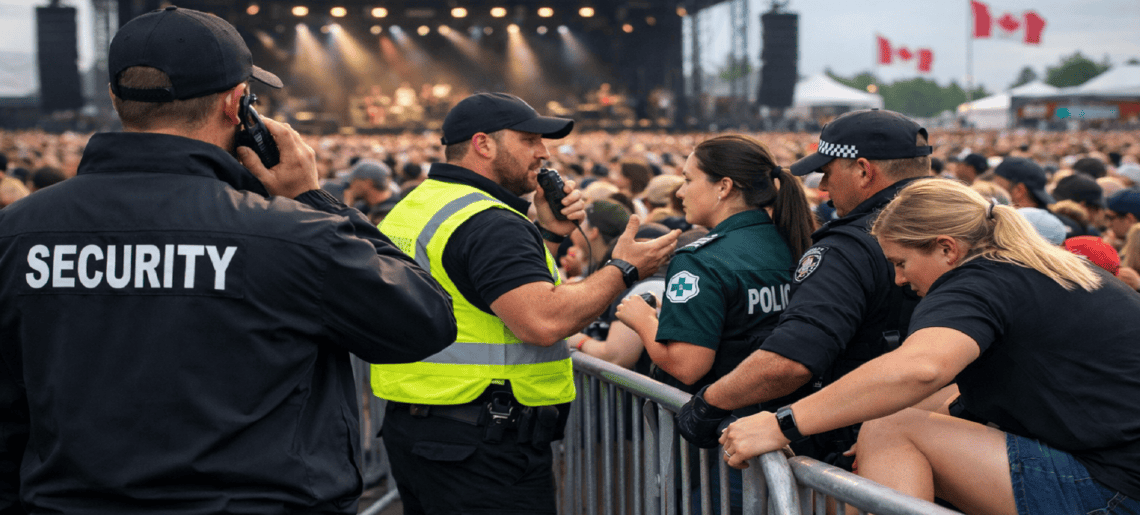
With no enforced capacity limits and limited tracking of attendees, the crowd grew beyond safe levels. Attendees reported being pushed, crushed, and struggling to breathe as pressure built near the stage. Security and police were forced to pull people over barricades to prevent serious injuries.
For Alberta security guards, this wasn’t just an isolated incident — it was a powerful reminder of how quickly crowd dynamics can escalate, and how critical proper training and planning are in preventing disaster.
The Myth of “Unpredictable” Crowds
In the aftermath of major crowd incidents, organizers often claim events were “unforeseeable.” In reality, crowd behaviour is highly predictable.
Overcrowding, bottlenecks, and surges follow known patterns. When density reaches critical levels, individual control disappears, and the crowd begins to move as a single force.
Well-trained Alberta security guards understand:
- Early warning signs of crowd compression
- How movement patterns develop
- When intervention is required
“Unpredictable” is not an excuse — it’s a failure to prepare.
Capacity Control Is a Safety Requirement
One of the biggest failures at the Stampede concert was the absence of real-time capacity tracking.
Free public events are especially vulnerable:
- No ticketing = no accurate attendance count
- High-profile performers = surge in demand
- Open access = uncontrolled entry flow
For security professionals in Alberta, the lesson is clear:
👉 You cannot control what you cannot measure
Capacity limits are not about restricting access — they are about preventing dangerous pressure buildup and ensuring safe movement throughout the venue.
Ensure the safety of your team and crowds by completing Event Security Training now.
Barrier Design Can Prevent — or Cause — Injury
Barriers are one of the most misunderstood tools in event security.
When used correctly, they:
- Guide crowd flow
- Create safe zones
- Maintain emergency access routes
When used incorrectly, they:
- Trap attendees
- Increase pressure points
- Contribute to crush injuries
At the Stampede concert, front-stage barricades became a hazard when crowd pressure surged forward with no relief points.
In Alberta event security, proper barrier planning must always include:
- Escape lanes
- Pressure release zones
- Controlled entry/exit points
Read about First Aid training for Event Security here.
Communication Is the Backbone of Event Safety
Post-incident analysis often reveals one common issue: communication breakdown.
Despite early warning signs and public concerns about overcrowding, no meaningful adjustments were made before the event.
Effective communication in event security includes:
- Clear chain of command
- Defined roles and responsibilities
- Shared terminology between teams
- Immediate escalation protocols
When seconds matter, confusion costs control.
Professional Composure Saves Lives
One of the most important — and often overlooked — skills in event security is maintaining calm under pressure.
At the Stampede incident, the composed response of security, police, and paramedics helped prevent panic and serious injury.
For security guards:
- Your behaviour influences the crowd
- Calm presence reduces panic
- Confidence builds trust
This level of composure is not instinctive — it is trained.
Prevention Is Always Better Than Reaction
The reality is simple: most crowd incidents are preventable.
Strong event security planning includes:
- Real-time capacity monitoring
- Coordinated communication systems
- Barrier and flow design
- Emergency response protocols
These are not advanced strategies — they are foundational principles.
Why Event Security Training Matters in Alberta
Inexperienced guards often underestimate the complexity of large-scale events.
They expect to:
- Monitor minor incidents
- Maintain presence
- Observe and report
But large events demand much more:
- Crowd psychology awareness
- Rapid decision-making
- Team coordination
- Emergency response execution
Professional event security training in Alberta prepares guards to:
- Recognize risks early
- Communicate effectively
- Act decisively without overreacting
Key Takeaways for Alberta Security Guards
- Watch the crowd, not the stage
- Report concerns early through the proper chain of command
- Use barriers to guide, not confine
- Communicate clearly and consistently
- Stay calm under pressure
- Learn from every event
Conclusion
The Calgary Stampede crowd surge was a warning — not a tragedy.
But it could have been.
For Alberta security professionals, it reinforces a critical truth:
👉 Event safety is not luck. It is preparation, training, and execution.
If you’re looking to build real-world skills in crowd management, communication, and event safety, investing in professional training is the next step.